Every July, more than 130,000 visitors go to the Great Yorkshire Show in Harrogate, in the north of England. Farmers show their best cows and sheep, but the food hall is just as popular: small producers sell cheese, jam, honey, cakes and apple juice from their stalls.
Emma is nineteen and works on her family's stall, "Dale Farm Dairy". At 8 a.m. she sets up the display: the cheeses are on wooden boards, every product has a price tag, and a plate of offered samples is ready at the front. "People buy with their eyes first," her mother says. At 9 o'clock the gates open, and the first customers arrive.
Some customers only want to taste. Others ask many questions: Is it organic? How long does it keep? Can I pay by card? A man from London wants the strongest cheese, and an old lady is looking for something cheaper than the blue cheese. Emma stays smiling, gives advice and suggests a gift box for three cheeses. By 5 p.m. she has sold almost everything, and a shop owner has asked for her business card: he wants to sell Dale Farm cheese in his shop.
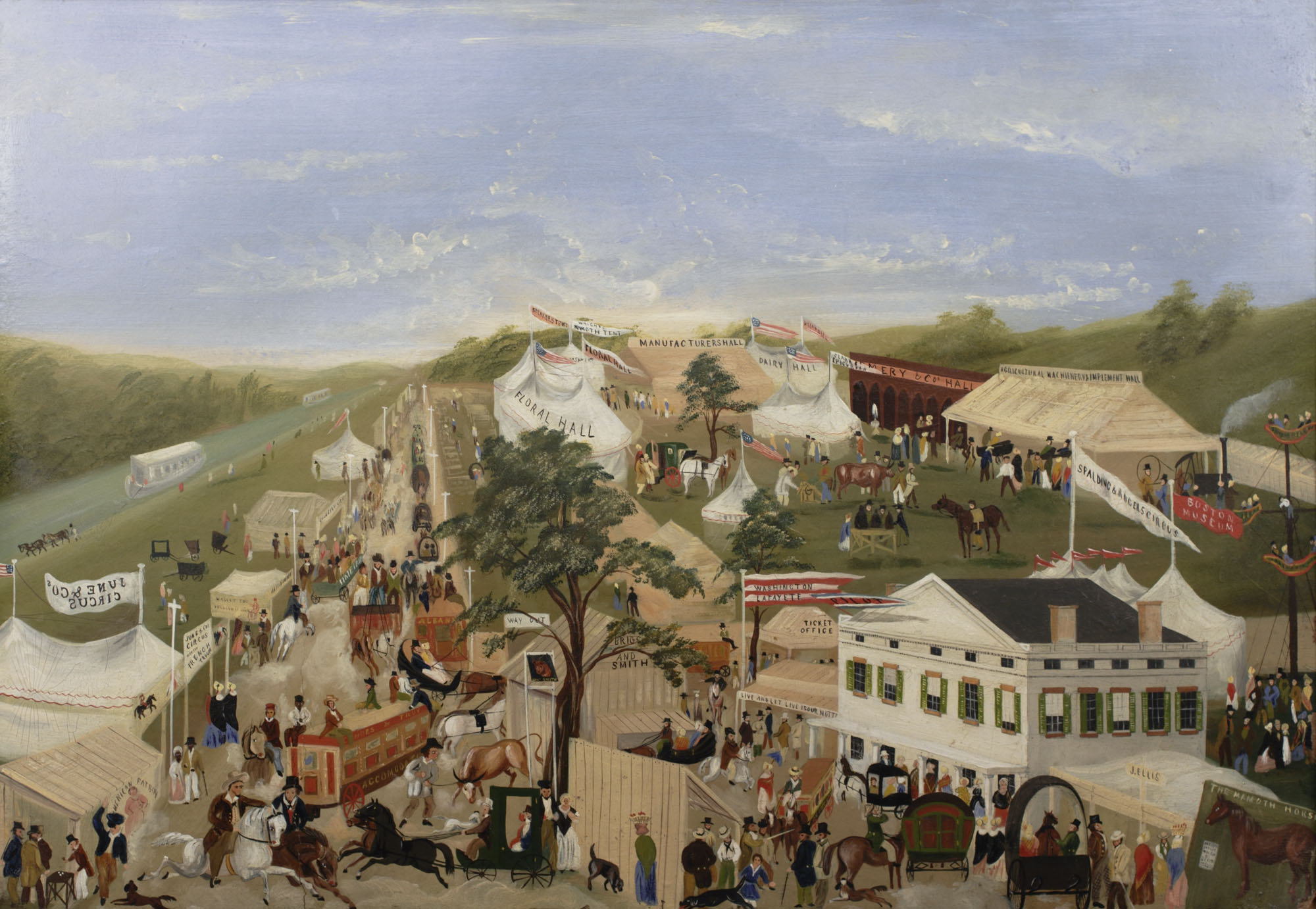
Attributed to John Wilson, New York Agricultural Fair of 1850, c. 1850, oil on board, Albany Institute of History & Art, gift of Ellen H. Leslie, 2013.21. Public domain.
Stalls, hay bales and a tractor at a country fair (Stands, bottes de paille et tracteur dans une fête agricole)A farmer and a sales adviser shake hands (Un agriculteur et un conseiller vente se serrent la main)
Look at the photos. What can you see? Where are the people? What are they doing?
Read the text in “Reading”. Answer in full sentences, then tap a question to check your answer.
A. Find the information
Where and when does the show take place?
In Harrogate, in the north of England, every July.
What do small producers sell in the food hall?
Cheese, jam, honey, cakes and apple juice.
What does Emma do at 8 a.m.?
She sets up the display: cheeses on boards, price tags and offered samples.
Which three questions do customers ask?
Is it organic? How long does it keep? Can I pay by card?
What happens at the end of the day?
She has sold almost everything and a shop owner asks for her business card.
B. True or false? Justify with a quotation.
The food hall is not very popular.
False: “the food hall is just as popular.”
All customers buy something.
False: “Some customers only want to taste.”
Emma suggests a bigger purchase.
True: “suggests a gift box for three cheeses.”
C. Read between the lines
What does “People buy with their eyes first” mean?
The display must be attractive: customers buy what looks good.
Why does Emma offer samples?
Because customers who taste are more likely to buy.
Why is the shop owner's request good news for the family business?
They can sell all year round, not only at the show: more customers and more money.
Which qualities of a good seller does Emma show? Give two.
She is patient and smiling, she gives advice, she sells more (gift box).
Grammar: asking questions
A good seller answers customer questions and also asks questions to understand what the customer needs. Study the rules, then do the tasks.
1. Question forms
Yes/No
Is it organic? / Do you take cards? / Can I try it?
Wh- questions
How much is it? / How long does it keep? / Who made it?
Polite requests
Could I help you? / Would you like a bag? / Can I ask you to wait a moment?
Indirect questions
Could you tell me how much this cheese costs? (no “does”, normal word order)
2. Find the question. Tap to check.
Answer: “It's £4.50 a jar.”
How much is it? / How much does a jar cost?
Answer: “It keeps for three weeks in the fridge.”
How long does it keep?
Answer: “Yes, we take cards and cash.”
Do you take cards? / Can I pay by card?
Answer: “My grandfather started the farm in 1985.”
Who started the farm? / When did the farm start?
3. Make it polite: write an indirect question.
How much does the honey cost? → Could you tell me…
Could you tell me how much the honey costs?
Is the cheese organic? → Do you know…
Do you know if the cheese is organic?
Where is the café? → Could you tell me…
Could you tell me where the café is?
What would you like? → May I ask…
May I ask what you would like?
4. Correct the mistake.
How much costs the jam?
How much does the jam cost?
Do you know where are the toilets?
Do you know where the toilets are?
Measurements
Useful conversions: 1 acre = 0.4 ha | 1 mile = 1.6 km | 1 pound (lb) = 454 g | 1 stone = 6.35 kg | 1 pint = 0.57 l | 1 foot = 30 cm
A customer wants a pound of cheese. How many grams is it?
About 454 g.
A jar of honey weighs 340 g. Is it more or less than a pound?
Less than a pound (454 g).
A bottle of apple juice is 1 pint. How many litres?
About 0.57 litres.
The car park is 2 miles away. How many kilometres?
About 3.2 km.
Cheese costs £6 a pound. How much for 2 pounds?
£12.
Comparing products
Comparatives: cheaper than, stronger than, more expensive than, better than. Superlatives: the cheapest, the strongest, the most popular, the best. Complete, then tap to check.
The blue cheese is ___ (expensive) than the cheddar.
more expensive
This cheddar is ___ (strong) than the mild one.
stronger
The gift box is ___ (good) deal on the stall.
the best
Honey is ___ (popular) product today.
the most popular
The small jar is ___ (cheap) than the big one.
cheaper
Our juice is ___ (fresh) than supermarket juice.
fresher
Advise a customer
A customer hesitates between two products. Compare them and recommend one.
Sentence starters: This one is cheaper than…, but… / If you like strong flavours, the best is… / I would recommend… because…
Your turn
1. Write (80–120 words)
Write a post for the Dale Farm Dairy page to invite customers to the stall at the show: present the products, compare two of them, give prices and a special offer.
Sentence starters: Come and visit us at… / Our… is the most popular… / It is cheaper/stronger than… / Special offer:… / See you at stall number…!
2. Role-play in pairs
Student A is the customer, Student B is the seller. The customer asks at least five questions (one indirect question, one about price, one comparing two products). The seller greets, offers a sample, compares, suggests a bigger purchase, gives the price and the change.
Sentence starters: Good morning, can I help you? / Could you tell me how much…? / Would you like to try…? / This one is stronger than… / That's £…, here is your change.
3. Make a poster
Design a poster for your stall: product, price, special offer and one sentence with a superlative.